
How do you make a film about a product you can only hear?
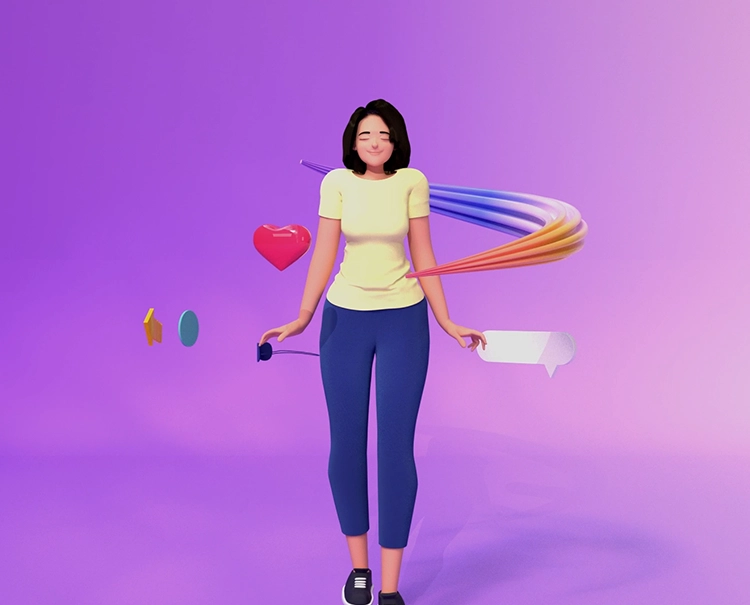
A cinematic 3D product film for In2Bliss — a guided-audio wellness app whose product is made almost entirely of sound, and whose results happen somewhere no camera can follow.
How do you make a film about a product you can only hear?
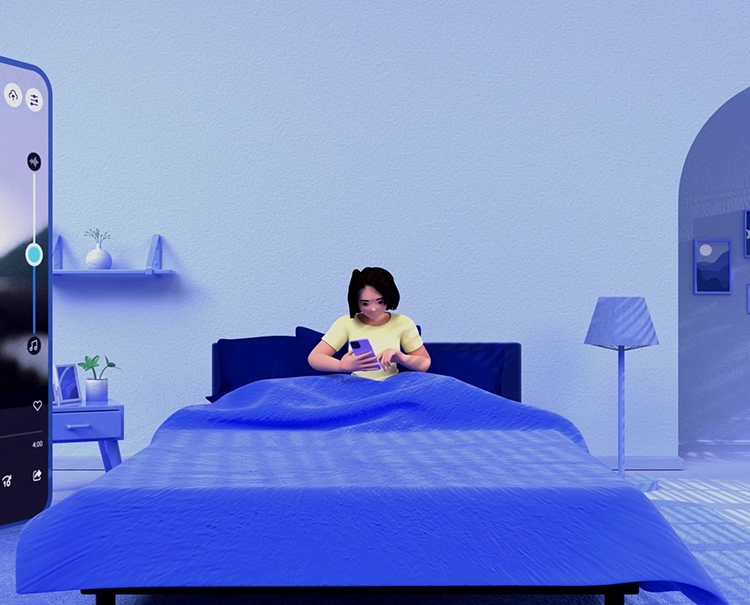
In2Bliss is a mobile app for the part of your mind you can’t reason with directly. It’s built around guided audio — affirmations, meditations and sleep sessions designed to run while you’re falling asleep, when the subconscious is most open to repetition.
About the Project
Two invisibilities, stacked
Around the audio sits the scaffolding that makes a practice stick: a meditation tracker with streaks, a gratitude journal, a library of binaural and ambient music, daily reminders, and the ability to record your own affirmations in your own voice.
The premise is that changing how you talk to yourself is a habit, not an insight — so the app is built to be returned to nightly rather than understood once.
The first problem is that the product is made of sound. A screen recording of In2Bliss shows a play button and a timer. The actual product is the twenty minutes of audio that follows, and none of it renders on a screen.
The second is that the outcome is internal. You cannot film someone sleeping better, or worrying less, or catching a negative thought before it lands. A SaaS product at least has a result you can point at — a report generated, a deal closed. This one has nothing external to show at all.
What we made
Visualizing the Abstract
We translated security concepts into:
- Dynamic 3D environments
- Layered protection systems
- Data flow visual metaphors
Building Trust Through Design
Cybersecurity buyers look for confidence signals.
We used:
- Clean, high-end 3D aesthetics
- Controlled motion and precision
- Dark, premium visual tone
Product-Centric Storytelling
Instead of generic animation, we focused on:
- The product as the hero
- Real use-case scenarios
- Clear problem → solution flow
The decision that shaped it
What changed
With no product to demonstrate and no outcome to document, the film had to make the audience feel the thing the app produces rather than show them evidence of it.
So the work went into what a viewer registers before they have consciously read anything — pace, light, the way one shot resolves into the next. Slow enough to lower a pulse rate. Precise enough to read as considered rather than soft.
We haven’t measured a result on this one, and we would rather say so than invent a percentage.
What we can say is what the film is for: it has to work with the sound off, in a feed, against a category where everything already looks the same. That is the hardest place a wellness product ever has to compete.
The third problem: an exhausted category
Why atmosphere had to carry the argument
Wellness has a visual language that is completely used up. Sunrises. Silhouettes on mountains. Hands cupping light. Slow-motion water.
Any film reaching for those would have been read as generic before the second second — not because the product is generic, but because the imagery is.
The interface appears in the film, but it isn’t the argument. The argument is that this app belongs to a category of one — and the way to make that case for something you can only hear is to give the eye something it hasn’t seen in that category before.
let’s get started right now
If you would like to work with us or just want to get in touch, we’d love to hear from you!
Rajshahi
House 409, Road 10, Padma R/A, Vadra, Rajshahi 6207
© 2020 – 2025 | Alrights reserved by Urban Sloth